
Proof of Work vs Proof of Stake: Stunning Best Comparison
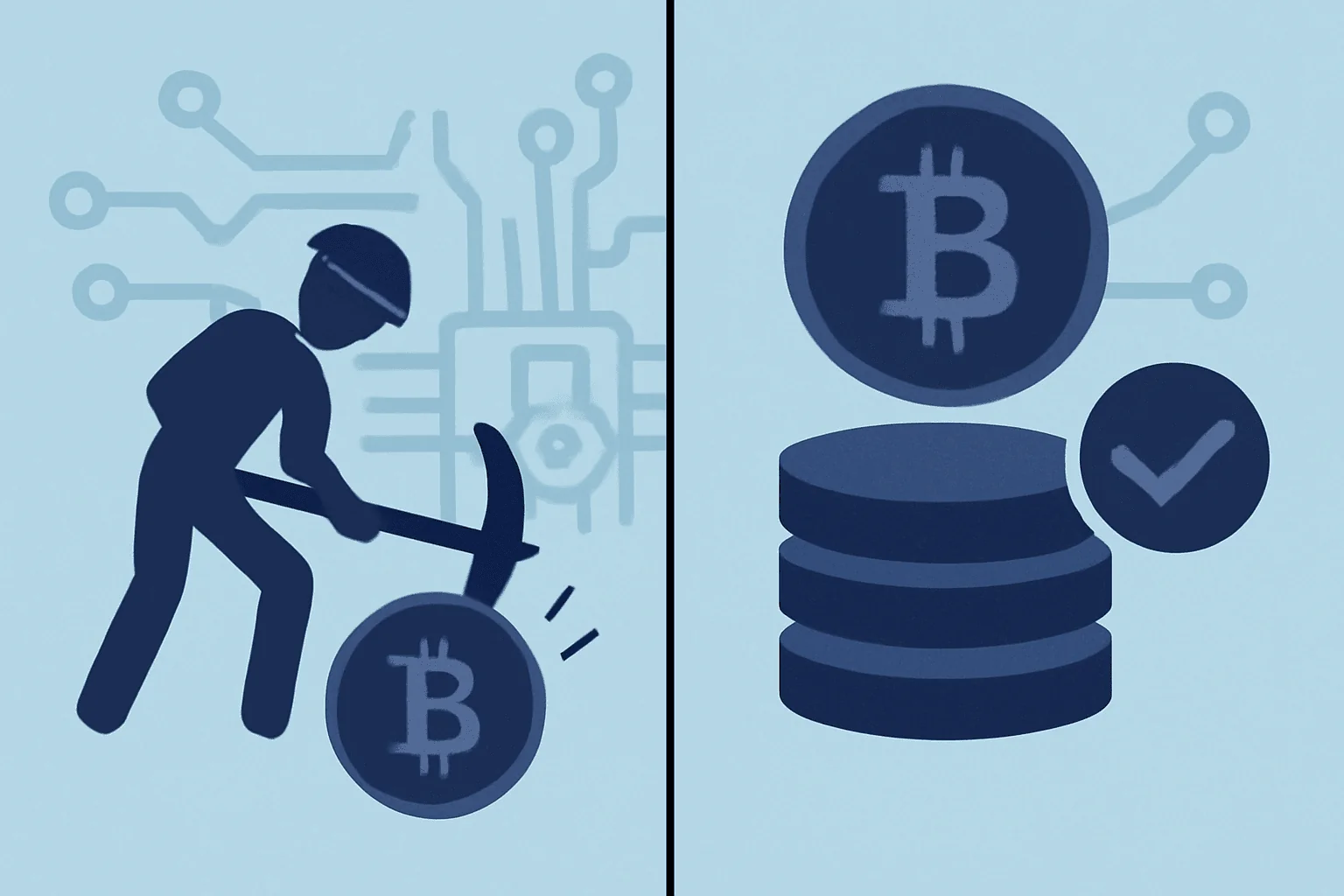

What PoW actually does
In Proof of Work, miners compete to solve a cryptographic puzzle. Finding the answer requires massive trial-and-error. The first miner to find a valid solution broadcasts a new block, earns the block reward, and collects fees. The security comes from the real-world cost: electricity and hardware.
Think of Bitcoin. A miner strings together transactions into a block, then hashes the block with a changing nonce until the output is below a target. Most attempts fail. The difficulty adjusts every ~2 weeks to calibrate block time. As more miners join, difficulty rises, and the network stays on schedule.
What PoS changes
Proof of Stake replaces energy expenditure with financial stake. Validators lock up native tokens (their “stake”) and get randomly chosen to propose or attest to blocks. If they act honestly, they earn rewards; if they cheat or go offline, they can be slashed—losing part of their stake.
On Ethereum post-merge, validators run nodes with 32 ETH per validator key. They propose blocks according to a pseudorandom schedule and attest to others’ blocks. Finality emerges once enough stake signs off. The cost to attack is buying or controlling a huge chunk of the token supply and risking slashing.
The core differences at a glance
Both systems prevent double-spending and define a canonical chain, but they pay for security with different resources and assumptions. The table below summarizes key dimensions.
| Dimension | Proof of Work (PoW) | Proof of Stake (PoS) |
|---|---|---|
| Security cost | Electricity + specialized hardware | Capital at stake (native token) |
| Attack requirement | Control ~51% of hash rate | Control large share of staked tokens |
| Penalty for misbehavior | Wasted energy, orphaned blocks | Slashing of stake, ejection |
| Hardware profile | ASIC/GPU farms, supply chain heavy | Commodity servers; networking critical |
| Environmental impact | High energy draw; location-sensitive | Low energy draw; orders of magnitude lower |
| Finality | Probabilistic; deeper confirmations = safer | Economic finality via validator votes |
| Fork handling | Nakamoto consensus, longest-chain by work | Fork choice with attestations (e.g., LMD-GHOST) |
| Entry barrier | Capital + energy + logistics | Capital stake; can delegate in some networks |
| MEV dynamics | Miner-extractable value | Maximal extractable value; often mitigated with PBS |
The security budget in PoW is paid continuously in power bills. In PoS, it’s the opportunity cost of locked capital plus slashing risk. Both are expensive in different ways, and that’s by design—cheap-to-attack systems don’t last.
Energy and environmental profile
PoW’s energy consumption is visible and measurable. Large Bitcoin miners negotiate power deals near stranded energy or hydropower, chasing cheap kilowatt-hours. That creates an industrial footprint and public scrutiny. On the upside, the off-switch is simple: if mining revenue drops, rigs power down, and energy use falls.
PoS barely moves the meter on energy. A validator can run on a modest server or cloud instance. This unlocks lighter hardware, wider geographic participation, and simpler home setups. One validator running on a small single-board computer staking a few thousand dollars illustrates the difference vividly.
Security assumptions and attack models
PoW resists attacks through external costs. To reorganize six Bitcoin blocks, an attacker needs sustained majority hash rate and cheap power. Even then, exchanges can wait for more confirmations. The attack burns cash whether it succeeds or fails.
PoS focuses on internalized penalties. A coordinated double-sign or equivocation can be detected and slashed. Long-range attacks are mitigated with checkpoints and weak subjectivity: nodes need a recent consensus snapshot when joining. That’s different from PoW’s “start from genesis and catch up” ethos, though modern PoW nodes also rely on trusted checkpoints for practicality.
Decentralization in practice
PoW decentralization is gated by hardware, power, and logistics. ASIC-heavy networks can gravitate toward industrial-scale miners. Yet custody of hash rate can shift quickly: rigs can be shipped, and energy deals expire.
PoS decentralization hinges on stake distribution and validator operations. If staking concentrates on a few custodians or liquid staking tokens, voting power clusters. Many networks counter this with caps, commission competition, and social norms. A small example: a new staker might split funds across three independent validators to avoid single-operator risk.
Throughput, fees, and performance
Consensus alone isn’t the main limiter—block size and propagation are. PoW typically keeps block times slow to reduce orphan risk (Bitcoin ~10 minutes, Litecoin ~2.5 minutes). PoS networks often target faster slots and finality, making fee markets more responsive.
On Ethereum PoS, block proposals occur about every 12 seconds with finality minutes later, while rollups handle most scaling. On Solana, a PoS variant with a different architecture pushes high throughput at the cost of higher hardware requirements and different failure modes. Trade-offs stack above the consensus layer.
Economic incentives and rewards
Miners sell coins to cover power and hardware, creating sell pressure that tracks hash economics. In bull markets, more hash joins until margins thin. In PoS, validators earn inflationary rewards and fees with minimal operating costs, so net issuance can be lower. Slashing sits like a sword over validators, pushing professional setups, monitoring, and key hygiene.
For a user choosing where to participate, the calculus is different. Running a small PoW rig at home might be infeasible or unprofitable. Running a PoS validator can be doable with diligence: redundant internet, a UPS, and a remote signer.
When each model fits
Some goals align better with one model. If your priority is neutrality anchored in a commodity-like external cost, PoW has a clean story. If you want quick finality and energy lightness while accepting social recovery tools and weak subjectivity, PoS fits.
- Store-of-value chains with slow, conservative design often prefer PoW’s simplicity and battle-tested dynamics.
- Smart contract platforms targeting high activity lean toward PoS to reduce energy use and support faster block cadence.
- App-specific chains may choose hybrid approaches or variants (e.g., PoS with committee-based finality) to match their risk profile.
Designers can even mix elements: PoW for data availability, PoS for validator selection, or PoW-backed checkpoints for bootstrapping trust.
Common misconceptions
PoW isn’t inherently “waste.” The energy expenditure is the security spend, deliberately convertible to cost by any attacker. And PoS isn’t “free security.” Capital at stake is real, and slashing outcomes can sting; the social layer must enforce client updates and handle edge cases.
- Finality: PoW finality is probabilistic but strong with depth; PoS finality is economic and can be reverted only with explicit social coordination.
- Decentralization: Both can centralize—PoW via mining pools and ASIC supply, PoS via staking services and governance capture.
- Onboarding: New nodes in PoS often need a recent checkpoint; this is a feature, not a flaw, to counter long-range attacks.
A quick scenario: an exchange waits 6 Bitcoin confirmations for a large deposit. On Ethereum, it might wait for finalized status. Different mechanics, same goal—settlement confidence.
What to watch next
Three developments will shape the debate. First, MEV management: proposer-builder separation, orderflow auctions, and encryption aim to reduce centralization pressure. Second, restaking and shared security could concentrate or decentralize power depending on safeguards. Third, energy markets keep evolving—PoW collocating with curtailed renewables or methane mitigation changes the narrative.
PoW and PoS aren’t moral opposites; they’re tools. The right choice depends on who must be kept honest, what they can afford to attack with, and how the community intends to recover when edge cases hit.